If you’re planning to study in the USA, one of the biggest questions is simple: How will you pay for it? Tuition fees, living costs, insurance—it all adds up quickly. For most students, especially international students, student loans become the main option.
But here’s the thing: student loans in the USA are not as straightforward as they seem. There are different types, interest rates, repayment rules, and even forgiveness programs. If you don’t understand them properly, you can end up in long-term debt.
Let’s break it down simply and practically.
Rising Cost of Education and Loan Burden
The cost of education in the USA has been rising for years. According to data from the Federal Reserve (2024):
- Total student loan debt in the U.S. crossed $1.77 trillion
- The average student loan in the USA is around $37,000 per borrower
- Over 43 million Americans have student loan debt
For international students, the situation is even more challenging. They:
- Don’t qualify for federal loans
- Often need a co-signer (a U.S. citizen or permanent resident)
- Face higher interest rates
For Indian students, the average education loan in the USA for Indian students can range from ₹20 lakh to ₹80 lakh, depending on the course and university.
Why This Becomes a Serious Issue
Let’s understand this with a real-life type scenario.
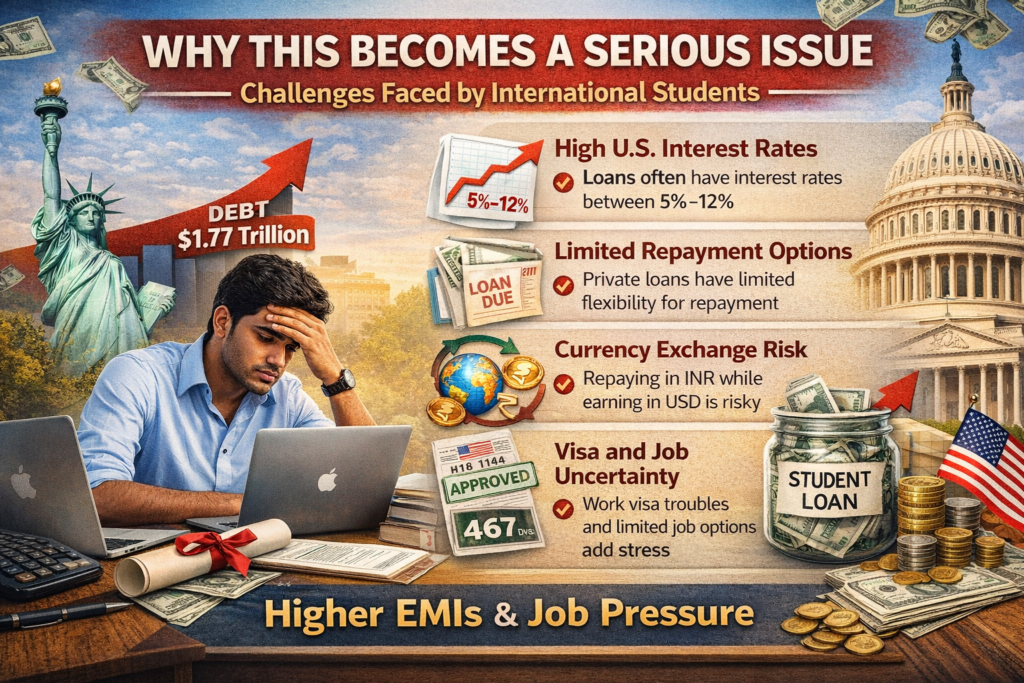
Rahul, an Indian student, went to the U.S. for a Master’s degree in Data Science. His total cost was about $60,000 (₹50 lakh approx.). He took a private student loan at an interest rate of 10% per year.
After graduation:
- His monthly EMI came out to around $700–$800
- He struggled initially because of job uncertainty
- Visa pressure (OPT + H1B) added stress
This is not a rare case. Many students face:
- High student loans U.S. interest rate (typically 5%–12%)
- Limited repayment flexibility for private loans
- Currency exchange risk (INR vs USD)
Even U.S. citizens are struggling. According to the U.S. Department of Education, millions are in default or have delayed payments.
Recent student loans, U.S. news also highlights:
- Ongoing debates on loan forgiveness
- Changes in repayment plans, like the SAVE Plan
- Legal challenges around forgiveness programs
Understanding Student Loans Smartly
Now let’s talk about solutions—what you should actually do.
1. Types of Student Loans in the USA
There are mainly two types:
a) Federal Student Loans (for U.S. citizens only)
- Lower interest rates (around 5%–7% in 2025)
- Flexible repayment
- Eligible for U.S. student loan forgiveness
b) Private Student Loans
- Available for international students
- Provided by banks, NBFCs, or fintech lenders
- Interest rates: 8%–12% (sometimes higher)
For student loans in the USA for international students, common lenders include:
- Prodigy Finance
- MPOWER Financing
- Sallie Mae (with co-signer)
2. Interest Rates and Costs
Current student loans U.S. interest rate (2025–2026):
- Undergraduate federal loans: ~5.5%
- Graduate federal loans: ~7%
- Private loans: 8%–12%+
Key tip:
Always check if the rate is fixed or variable.
3. Repayment Options
Understanding U.S. student loan repayment is very important.
Common repayment plans:
- Standard (10 years fixed)
- Income-Driven Repayment (IDR)
- Graduated repayment
Example:
If your salary is low initially, IDR plans can reduce monthly payments based on income.
4. Loan Forgiveness Programs
One of the most searched topics today is U.S. student loan forgiveness.
Some options include:
- Public Service Loan Forgiveness (PSLF)
- Income-driven forgiveness (after 20–25 years)
But an important note:
👉 Most forgiveness programs are only for federal loans, not private loans
👉 International students usually don’t qualify
5. History of Student Loans in America (Short Insight)
The history of student loans in America goes back to:
- 1958: National Defence Education Act (first federal loans)
- 1965: The Higher Education Act expanded loans
- 2000s–2020s: Rapid increase in tuition and debt
Over time, loans became easier to access—but also harder to repay due to rising costs.
6. Smart Strategy for Indian & International Students
If you are planning to take a loan:
✔ Compare lenders
Don’t go with the first option. Compare interest rates and repayment terms.
✔ Borrow only what you need
Avoid taking extra money for lifestyle expenses.
✔ Look for scholarships
Even partial funding can reduce the loan burden.
✔ Plan your ROI
Choose courses with strong job prospects (STEM, healthcare, tech).
✔ Understand currency risk
If you repay in INR but earn in USD, fluctuations matter.
Final Thoughts
Student loans in the USA can open doors—but they can also create long-term pressure if not managed well.
The key is simple:
- Understand the numbers
- Plan your repayment early
- Avoid over-borrowing
Whether you are searching for student loans in the USA for international students or exploring an education loan in the USA for Indian students, always think beyond just getting approval.
Because at the end of the day, the loan is easy to take—but repayment is the real journey.