Artificial Intelligence has rapidly become a part of everyday life. Tools like ChatGPT and Gemini are now widely used for writing, research, coding, learning, and even decision-making. As these technologies become more powerful and accessible, a common question is emerging: Is AI reducing human thinking power? Are people becoming overly dependent on AI instead of using their own minds?
The debate between AI and human intelligence is growing quickly. While some believe AI is making humans lazy, others argue that it is simply a powerful tool that enhances productivity and knowledge. To understand the real impact, we need to explore how AI is affecting human thinking, learning habits, and the future relationship between humans and technology.
The Rise of Artificial Intelligence in Daily Life
Artificial Intelligence tools have become extremely popular in recent years. Students use AI to summarize notes, professionals use it for writing emails and reports, and businesses rely on AI for automation and data analysis. The convenience and speed of AI make it attractive for almost every task.
This rapid adoption has raised concerns about AI dependency. When people start relying on AI for answers, ideas, and problem-solving, they may gradually reduce their own mental effort. Instead of thinking deeply, many users simply ask AI for quick solutions.
However, this situation is not entirely new. In the past, people had similar concerns about calculators, search engines, and smartphones. Each technological advancement changed the way humans process information. AI is simply the next stage in this evolution.
ChatGPT’s Impact on the Brain and Human Thinking
One of the biggest concerns about AI is ChatGPT’s impact on the brain. Critics argue that if people rely too much on AI-generated answers, they may stop practicing critical thinking and problem-solving skills.
For example, students might use AI to write essays instead of developing their own arguments. Professionals may depend on AI for creative ideas instead of brainstorming themselves. Over time, this could potentially weaken human thinking power.
But the impact depends largely on how AI is used. If AI is treated as a shortcut to avoid thinking, it may reduce intellectual effort. On the other hand, if AI is used as a learning assistant, it can actually enhance understanding.
For instance, AI can explain complex topics, generate examples, and help users explore new perspectives. In this sense, AI becomes a tool that supports human intelligence rather than replacing it.
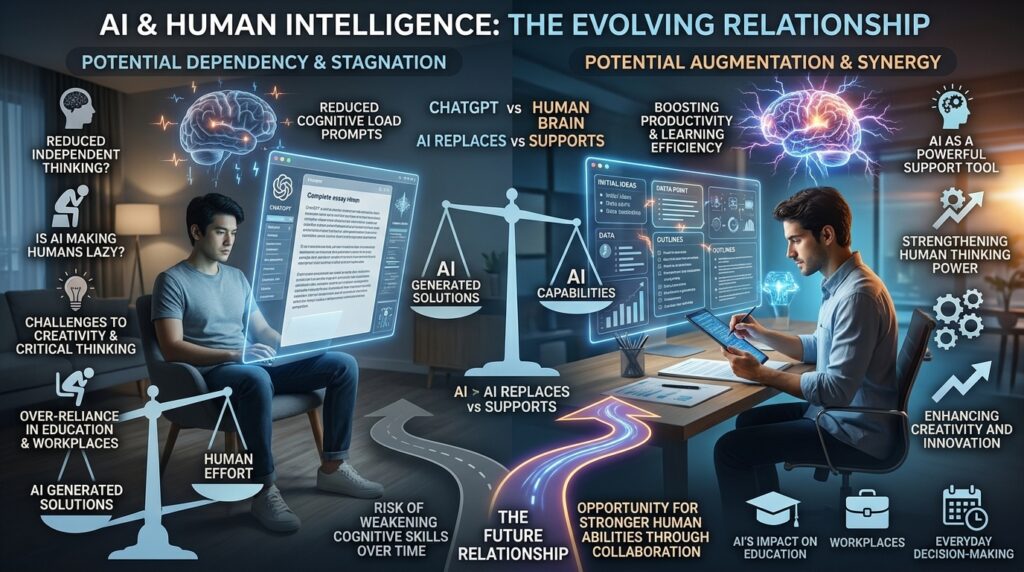
ChatGPT vs Human Brain: Who Is Smarter?
The comparison between ChatGPT and the human brain is often misunderstood. AI systems are extremely powerful at processing large amounts of information quickly. They can analyze data, generate text, and provide instant responses.
However, the human brain still has abilities that AI cannot fully replicate. Humans possess creativity, emotional intelligence, ethical judgment, and real-world understanding. AI works based on patterns and data, while humans can think abstractly and make decisions based on experience and values.
Therefore, the discussion should not be about AI replacing humans. Instead, it should focus on collaboration between AI and human intelligence.
When humans use AI wisely, it can increase productivity and allow people to focus on more meaningful and creative work.
Gemini AI vs Humans: Competition or Collaboration?
Another important discussion involves Gemini AI vs Humans. As AI models become more advanced, some people fear that machines might eventually outperform humans in many intellectual tasks.
In reality, AI systems like Gemini are designed to assist humans rather than compete with them. They can help analyze large datasets, generate insights, and support decision-making processes.
Humans, however, remain essential for interpreting results, making ethical choices, and applying knowledge in real-world situations. AI may provide suggestions, but humans are still responsible for final decisions.
This relationship shows that the future will likely involve human-AI collaboration, where both intelligence systems work together.
AI Technology Impact on Society
The AI technology’s impact on society is already visible in education, healthcare, business, and entertainment. AI tools are increasing efficiency and enabling faster access to information.
For example, doctors can use AI to analyze medical data, researchers can process large datasets quickly, and students can receive personalized learning support. These benefits show that AI has the potential to enhance human capabilities rather than diminish them.
However, responsible usage is important. Over-reliance on AI without critical thinking can create problems such as misinformation, reduced creativity, and poor decision-making.
Therefore, the key challenge is learning how to balance AI assistance with independent thinking.
Is AI Making Humans Lazy?
The question “Is AI making humans lazy?” depends largely on human behavior rather than the technology itself.
AI can certainly make tasks easier and faster. While convenience is beneficial, it can also encourage people to avoid mental effort. If users rely entirely on AI-generated content, they may gradually reduce their own creativity and analytical skills.
However, when used responsibly, AI can actually encourage deeper learning. For example, users can ask AI to explain difficult concepts, compare multiple viewpoints, or generate study materials.
In this way, AI becomes a learning partner rather than a replacement for human thinking.
The Future of AI and Humans
The future of AI and humans will likely involve close cooperation between artificial and human intelligence. AI will continue to automate repetitive tasks, analyze large volumes of data, and support decision-making processes.
Meanwhile, humans will focus on areas where they excel, such as creativity, empathy, leadership, and strategic thinking.
Instead of weakening the human brain, AI has the potential to expand human knowledge and productivity if used wisely. Education systems and workplaces will need to teach people how to work effectively with AI while maintaining strong critical thinking skills.
Conclusion
The debate about AI vs Human Intelligence is complex and evolving. Tools like ChatGPT and Gemini are transforming how people access information and perform tasks. While concerns about AI dependency and reduced thinking power are valid, the overall impact depends on how individuals choose to use these technologies.
Artificial Intelligence should not be seen as a replacement for the human brain. Instead, it should be viewed as a powerful tool that enhances learning, productivity, and innovation.
The future will not be a battle between humans and AI. Instead, it will be a partnership where human intelligence and artificial intelligence work together to solve complex problems and create new opportunities.